
Patent pending • Sustainable AI • Public-safety coordination
The future of emergency response is sustainable, coordinated intelligence.
LifeLink AI turns fast-moving 911 activity into a live, local-first intelligence layer that helps every authorized role stay coordinated, informed, and aligned around what matters most — when every second, every update, and every role can change the outcome.
Dispatch, supervisors, EMS, fire, law enforcement, emergency management, public works, hospitals, and leadership each get the view they need while staying connected to one shared incident truth.
Built beside CAD, radio, GIS, NG911 workflows, RMS, and existing protocols — not replacing them.
Coordinated intelligence for the moments that define the outcome.
Coordinate the changes. Direct the update. Align every role. Sustain the mission.
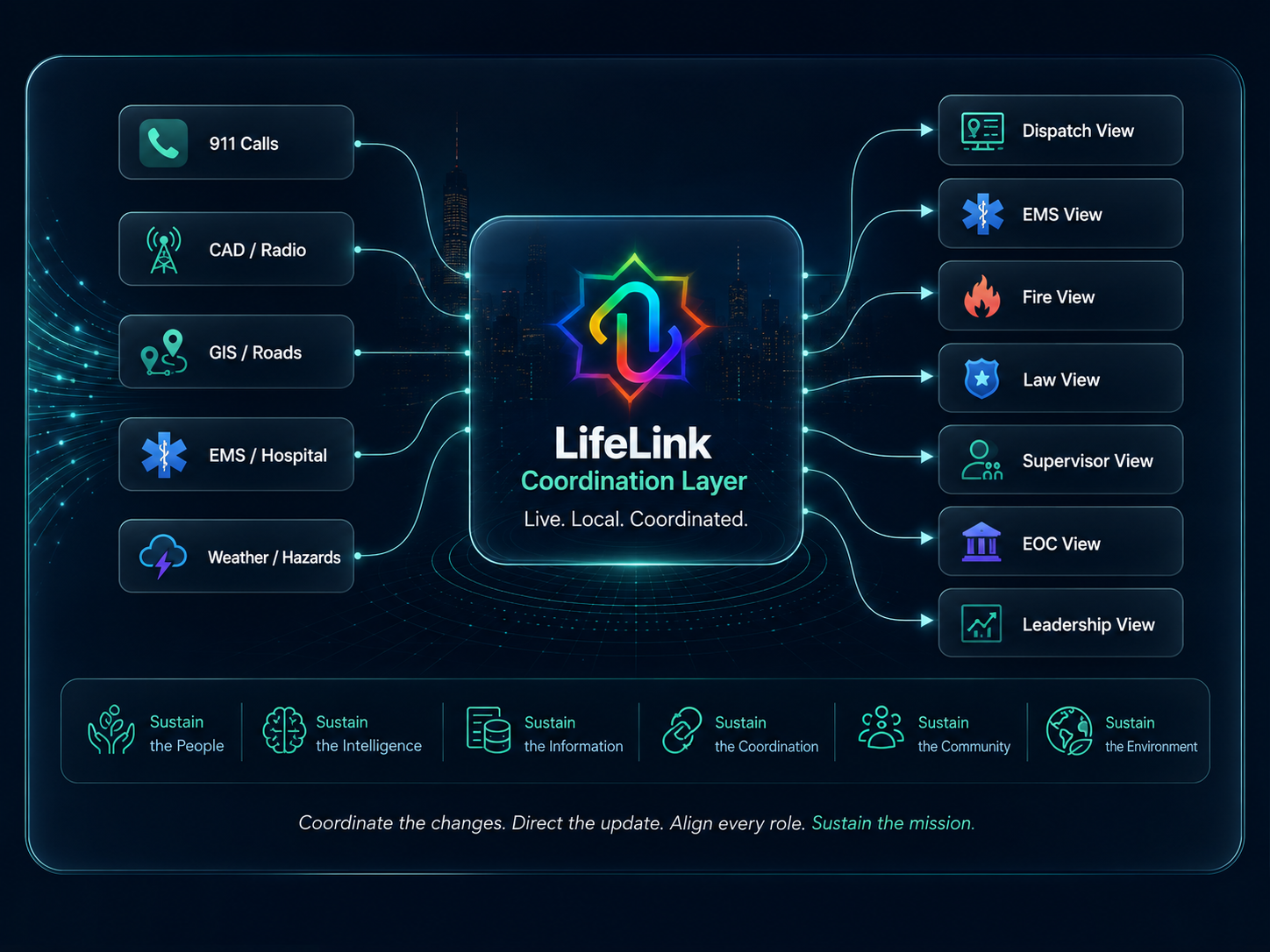
What sustainable means here
Sustainable means the system can keep carrying the mission.
For LifeLink, sustainable AI is not just about the environment. It is about building emergency intelligence that sustains the people, the information, the coordination, and the communities behind public safety.
Sustain the people
Reduce cognitive overload, repeated reconstruction, and unnecessary information burden on dispatchers, supervisors, and responders.
Sustain the intelligence
Use the right level of AI for the task — local-first where possible, selective where needed, and always in service of human judgment.
Sustain the information
Preserve what matters for QA/QI, training, after-action review, reporting, and future readiness.
Sustain the coordination
Help every authorized role stay aligned as incidents, updates, units, and conditions change.
Sustain the community
Turn today’s emergency patterns into clearer insight for safer roads, stronger readiness, and better local outcomes.
Sustain the environment
Reduce unnecessary external processing, avoidable data movement, and compute waste by keeping intelligence closer to the source.
Role-specific coordination
One incident. Different views. Shared clarity. Coordinated response.
LifeLink gives each authorized role the view they need while keeping the full response connected.
911 / ECC Leadership
Visibility, dispatcher support, supervisor awareness, and cross-department pilot growth.
View role insights →Dispatch
Urgent changes, duplicate-call awareness, language needs, and location clarity.
View role insights →Supervisor
Timelines, escalation, decision points, QA/QI, and coaching context.
View role insights →EMS
Patient condition, injury severity, transport context, and readiness needs.
View role insights →Fire
Entrapment, access barriers, hazards, fire, smoke, and blocked routes.
View role insights →Law Enforcement
Scene safety, roadway blockage, movement risk, and public-safety updates.
View role insights →Emergency Management
Resource strain, clusters, cross-jurisdiction alerts, and EOC-ready awareness.
View role insights →Roadway Safety
Crash clusters, closures, repeat corridors, and grant-aligned safety reporting.
View role insights →Human-centered response support
Built for the people carrying the emergency.
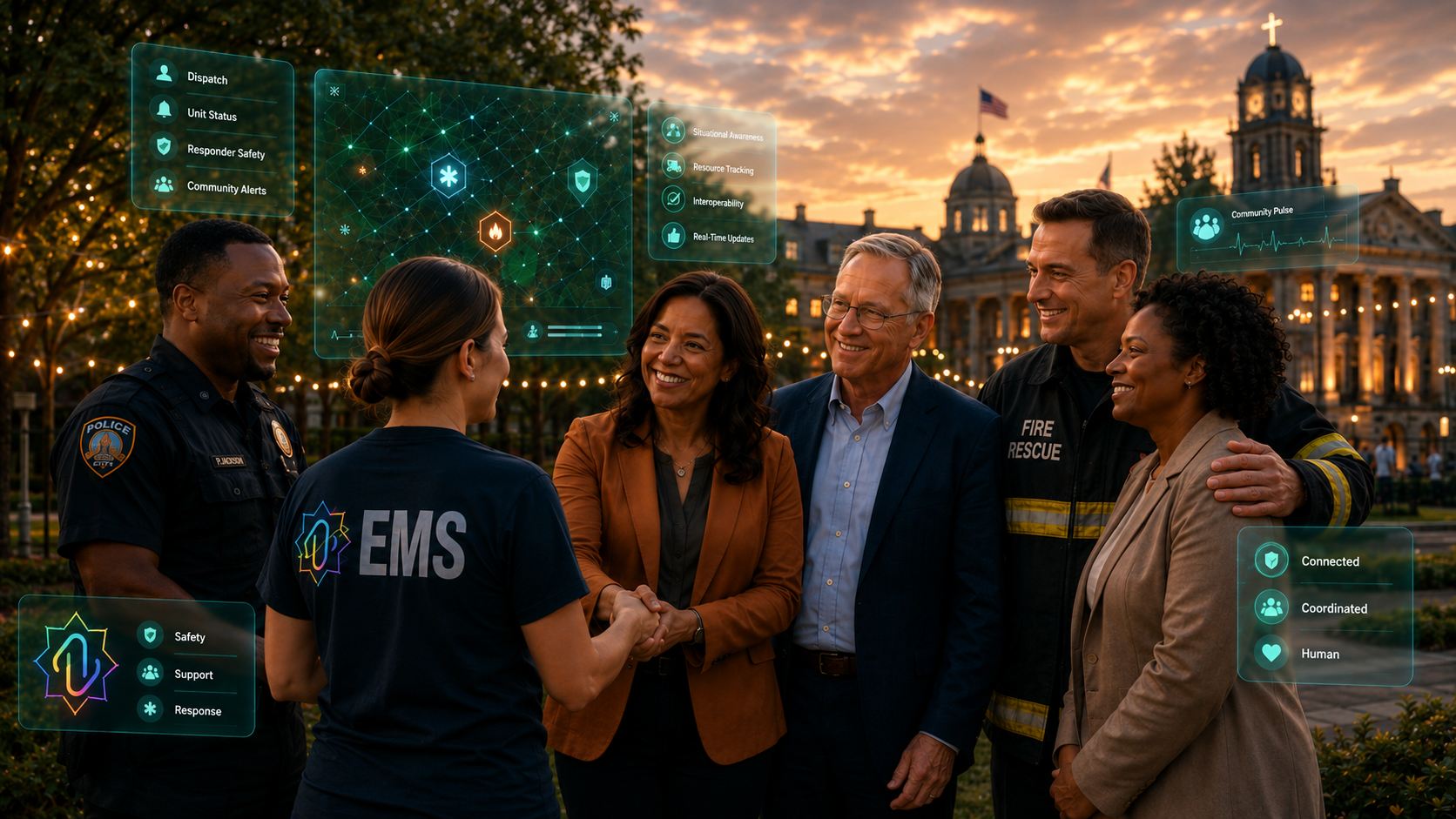
Every emergency has more than data behind it. There is a caller trying to be understood. A dispatcher carrying the pressure. Responders moving toward uncertainty. Supervisors trying to protect the full picture. A community depending on the system to work when it matters most.
LifeLink was created to help public-safety teams move through high-pressure moments with more clarity, stronger coordination, and better support.
More human. More local. More supportive.
Pilot ready
Start small. Prove value. Grow with confidence.
LifeLink can begin as a focused pilot around the problem your agency wants to solve first — then expand into broader cross-department coordination as value becomes clear.
Dispatch + Supervisor Pilot
Duplicate-call awareness, urgency changes, timeline visibility, QA/QI, and coaching-ready summaries.
Live Training Portal Pilot
Convert real, simulated, or replayed incidents into trainee decision practice with dispatcher notes and timeline comparison.
Continuity + PACE Readiness
Support HA-aware visibility, degraded-operations training, and fallback communication awareness.
Ready to find the right LifeLink pilot?
In a short pilot-fit review, we can identify the strongest use case, the right roles to include, the best package to start with, and whether a grant-aligned path makes sense for your agency.